
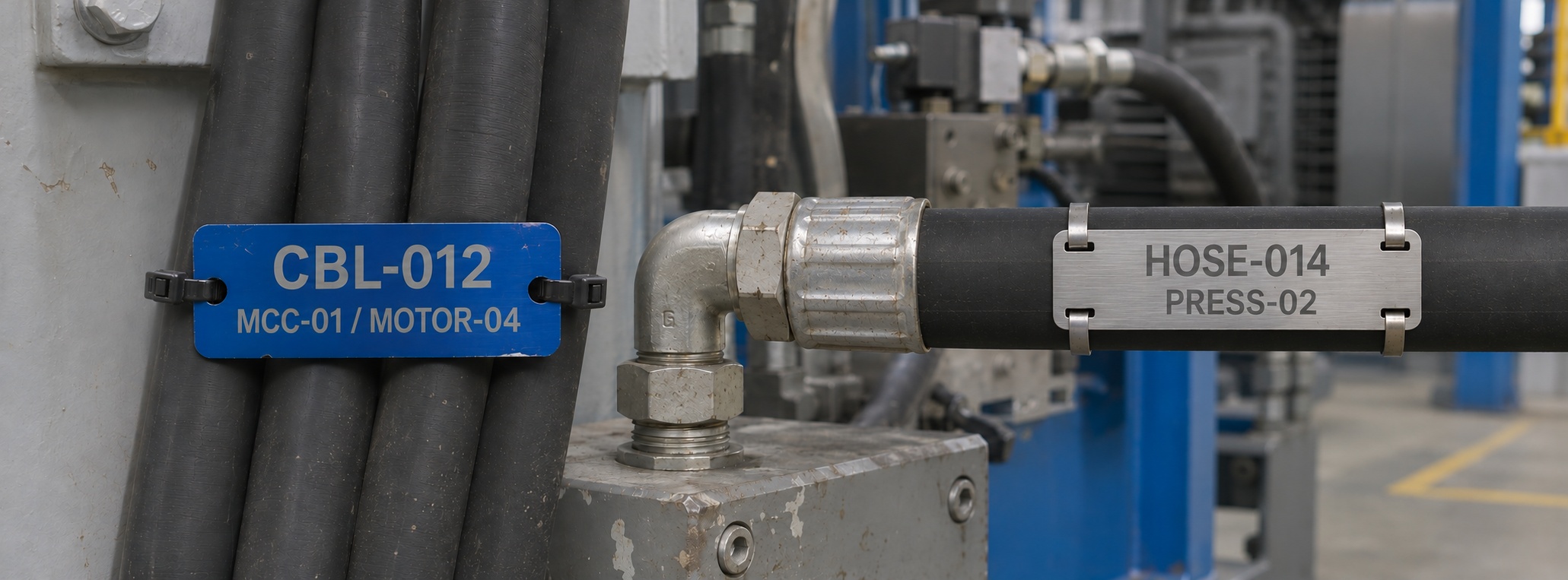
Illustrative cable and hose tag installation.
Custom cable identification tags and hose tags from Inland Products help identify cable runs, wire bundles and hose assemblies. Our cable and hose identification options include stainless steel and anodized aluminum tags with your equipment IDs, line references, serial numbers or other project-specific wording.
Choose a stock shape or specify custom dimensions and mounting details. Order matching identifiers for both ends of a line, different text on each tag, or blank tags for your own marking process.
Request a Cable & Hose Tag Quote Explore Tag Options
Made in the USA · Stock and custom sizes · Individual IDs and project quantities
Choose your cable and hose tags
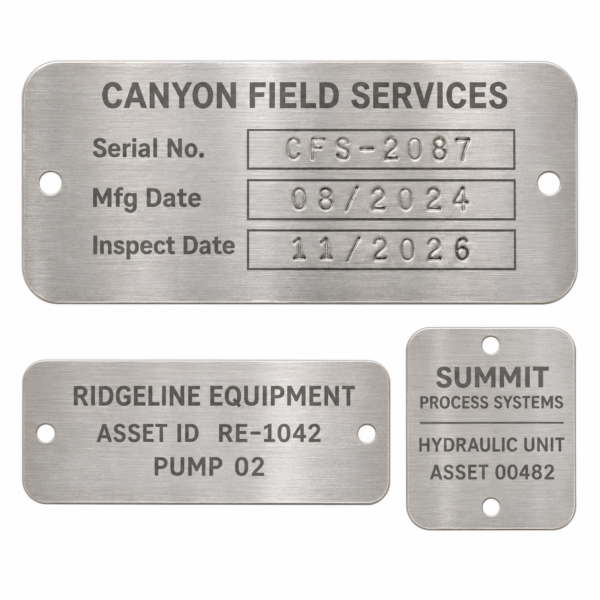
Stainless steel cable tags
Specify engraved stainless steel tags for industrial identification where material strength and exposure conditions matter. Choose 304 or 430 stainless steel in 0.030 or 0.050 inch thicknesses. Finish options include tumbled, brushed and 2B dull smooth; available combinations depend on the product configuration. Include your required grade, finish and thickness in the quote request.
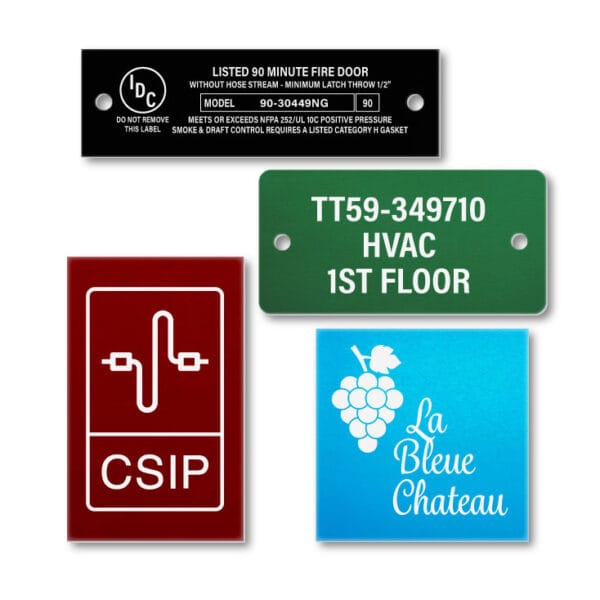
Anodized aluminum cable tags
Use lightweight aluminum tags in 0.020 or 0.040 inch thicknesses, with contrasting laser-etched text and a choice of background colors. Color can help distinguish systems, areas or line groups alongside the written identifier.
Blank and custom tag formats
Choose blank tags for in-house marking or send dimensions and a drawing for a custom engraved design. Specify holes or slots to suit the intended attachment and available installation space.
Cable identification tags and wire tags
Give each cable run or wire bundle an identifier that matches your drawings, equipment list and maintenance records. Engraved cable tags can display a cable number, origin and destination, circuit reference or installation location using the wording you supply.
For paired identification, request two tags with the same ID and specify how many copies are needed. For several systems, include the area or equipment reference in your tag schedule so similar-looking cable runs remain distinguishable.
Typical identification fields include:
- Cable or wire-bundle ID
- From/to equipment references
- Panel, circuit or terminal references
- Area, system or drawing reference
Specify the attachment location and available clearance. Tag material and fastening should suit the cable jacket, operating environment and project requirements.
Hose identification tags for assembly tracking
Custom hose tags help connect an individual assembly to the records used for maintenance and replacement. Add your hose ID, assembly number, equipment reference, manufacture date or a reference to an inspection record.
For hydraulic hose tags, supply the exact information approved for the assembly. If pressure ratings, test dates or service limits are included, provide that wording from your own verified records; Inland manufactures the identification tag to your supplied data.
Metal hose tags can also carry a unique serial number or a QR code linking to a customer-maintained record. Include the intended code size, scan requirements and encoded data with the quote request. Code layout and available engraving space require review.
Hose identification plates for OTC Industrial Technologies
Inland manufactured custom hose identification plates for OTC Industrial Technologies using 3.0 × 1.5 inch black anodized aluminum, 0.020 inch thick. The plates featured silver laser-etched identification, rounded corners and two mounting slots.
The 0.020 inch thickness allowed the plates to conform to the hoses they were applied to. This project required a thin aluminum construction that could follow the hose surface, with a slotted mounting layout and contrasting identification.
Materials and mounting options
| Option | Useful starting point | Include in your request |
|---|---|---|
| Stainless steel | Industrial metal identification with engraved text | Required grade, finish, thickness and exposure conditions |
| Anodized aluminum | Lightweight tags and visual color grouping | Color, dimensions, marking layout and outdoor exposure |
| One-hole tags | Hanging identification where clearance allows | Hole diameter and proposed attachment |
| Two-hole tags | Two attachment points for the specified installation | Hole spacing, hole diameter and mounting arrangement |
| Slotted tags | A strap or band passed through a suitable slot | Strap width/thickness, slot dimensions and installation drawing |
Specify the mounting pattern and fastener together
For holes, provide the quantity, diameter and center locations. For slots, provide the quantity, length, width and center locations, along with the strap or band width and thickness. Include the cable or hose outside diameter and the available mounting clearance.
For a four-slot stainless steel hose tag secured with two metal bands, show all four slot positions and the intended band routing on the drawing. Keep both bands clear of the identification and any code. Specify whether attachment hardware is required in the quote; the tag pattern and fastener must be reviewed for the installation.
For moving or flexible lines, include a drawing or photograph showing the proposed location. Provide chemical exposure, temperature and outdoor conditions when requesting material guidance. Anodized colors may fade with prolonged direct sunlight; color should support, rather than replace, a readable identifier.
Choosing a tag size and readable layout
Start with the number of text lines, required character height and space between mounting features. Keep identifiers readable after installation and leave room around holes or slots so the fastener does not cover the text. Short cable numbers need less space than from/to references or hose assembly details.
The N-25 stock format provides a specific size to compare with your installation:
| N-25 material | Size and thickness | Mounting |
|---|---|---|
| Anodized aluminum | 1 × 3 inches; 0.040 inch thick | Two 1/8-inch holes |
| 430 stainless steel | 1 × 3 inches; 0.030 inch thick | Two 1/8-inch holes |
These are stock two-hole formats. The OTC plates above were a separate custom two-slot design. If your drawing requires 304 stainless steel, different dimensions or slots, specify those requirements in a custom quote. See the stock tag dimensions for other formats.
Stainless steel or aluminum for cable and hose identification?
Aluminum is useful when low weight and color grouping are priorities. Stainless steel is an option when a project specifies a steel tag or greater material strength. Match the grade, finish and attachment to the actual environment: neither material should be assumed suitable for every chemical, temperature or exposure. Supply those conditions with your quote request.
Send a cable or hose tag schedule
Download the cable and hose tag schedule template (Excel). It includes project specifications, a blank tag list and separate examples for paired cable tags and hose identification.
For a project with different identifiers, send a spreadsheet with one row for each unique tag design and a quantity column for repeat copies. Keep leading zeros, prefixes and punctuation exactly as required. Separate each text line into its own column and identify the current file revision.
Illustrative identification schedule — sample wording only
| Tag ID | Text line 2 | Text line 3 | Quantity |
|---|---|---|---|
| CBL-001 | FROM: MCC-01 | TO: PUMP-03 | 2 |
| CBL-002 | FROM: PANEL-02 | TO: MOTOR-04 | 2 |
| HOSE-014 | ASSEMBLY: H-014 | UNIT: PRESS-02 | 1 |
The example contains three unique identifiers and five physical tags: two copies of each cable ID and one hose tag. State whether paired tags have identical wording or different end-specific text.
Add material, dimensions, thickness, finish/color and mounting details to each row or group of identical specifications. For QR codes or barcodes, include a separate column containing the exact data to encode. Send a dimensioned drawing for hole centers, slot sizes and any required text heights.
Review the tag proof and project data
Include your artwork or request a proof with the quote. Review the layout against the current tag schedule and dimensioned drawing:
- Construction: confirm material, grade, thickness, finish, overall size, corners and every hole or slot location.
- Readability: check the longest identifier, text height and line breaks on the smallest tag size. Keep mounting hardware outside the marking area.
- Data and quantities: compare spelling, leading zeros and prefixes with the source file. Confirm the number of unique designs and the physical copies of each.
- Codes: check the exact encoded value separately from the visible ID. For a web link, verify the full destination address and access requirements.
- Project organization: identify the approved file revision and any requested grouping, packing or end-specific wording.
A layout proof lets you review content and dimensions. For fit, conformity to the hose or scanner performance, discuss a physical sample and the intended installation conditions with your quote.
Pricing, quantities and lead times
Pricing depends on material, dimensions, thickness, marking, mounting details and quantity. Use the relevant product configurator for a defined specification, or request a project quote for mixed sizes and individual tag data. Minimum quantities and quantity discounts vary by product.
Allow 5 business days for stock blanks and typically 10–15 business days for custom tags. Confirm the schedule for engraved stock tags, large quantities or special requirements with your quote, and include your required delivery date and destination.
Cable and hose tag FAQs
Can every tag have a different number or wording?
Yes. Supply the text for each tag and the quantity of each identifier. A spreadsheet is useful for sequential IDs, paired cable-end tags and mixed project lists.
Can I order blank cable tags?
Yes. Inland offers blank tags in stock and custom formats for your own marking process. Choose a material and finish compatible with your marking equipment.
Are these the same as adhesive cable labels or heat-shrink markers?
This page focuses on engraved or blank identification tags attached using specified holes or slots. If your drawing calls for a wraparound adhesive label, heat-shrink sleeve or another marker format, include that requirement so suitability can be reviewed before quoting.
Can tags include QR codes or barcodes?
Include the code type and exact encoded data in your request. The tag size, mounting space, marking contrast and scanning conditions determine the practical layout. Leave a clear area around the code and keep fasteners outside it. Test a representative sample using your intended scanner, distance and lighting before committing to a large rollout. A code can point to your existing records; record hosting or tracking software is not included with the tag.
How do I choose the mounting holes or slots?
Start with the fastener dimensions and installation location. Supply the hole diameter or slot width and length, plus distances from feature centers to the tag edges. A dimensioned drawing is best for custom layouts.
What information should I send for a quote?
Send quantity, material, size, thickness, finish or color, mounting details, engraving data, delivery destination and required date. Include relevant environmental conditions and a tag schedule for different identifiers.
Request your cable and hose identification quote
Send your tag list, drawing or sample specifications. Inland will quote the material, dimensions, marking and quantities your project requires.
Related identification: Equipment tags · Valve tags · Electrical panel labels